Showing posts with label soft skills. Show all posts

Wednesday, October 29, 2014

Ways to Overcome ‘Impostor Syndrome’

At some point in their professional lives, everyone, no matter how successful, feels like they’re a fraud. Even luminaries like Maya Angelou, Tina Fey, Neil Gaiman, Sheryl Sandberg and Sonia Sotomayor have written or spoken about the feeling of impending doom that would come with being “found out.” And that great indicator of the national pulse, The Onion, published an article earlier this year titled “Report: Today the Day They Find Out You’re a Fraud.”

At StartupBros, Kyle Eschenroeder listed 21 ways to overcome that feeling. Here’s his list:

1.     Come off it. It may seem counterintuitive, but it’s healthy to recognize that you’re not as important as you think you are. The standard of perfection that you feel you have to hit probably isn’t as high as you think.
2.     Accept that you have had some role in your successes. After all, you did something to get where you are.
3.     Focus on providing value. As Eschenroeder says, “The fastest way to get over feeling like a fraud is to genuinely try to help someone else.”
4.     Keep a file of people saying nice things about you. You can revisit them whenever you’re feeling down about your work.
5.     Stop comparing yourself to that person. You don’t need to hit the standard of Einstein or Gandhi, or even that perfectly put-together classmate on Facebook. Learn to respect your own experience.
6.     Expose yourself totally. Eschenroeder describes impostor syndrome as a kind of “twisted arrogance.” This is akin to “come off it,” in that other people likely don’t hold you to as high a standard as you hold yourself. Let down your guard — it’s freeing.
7.     Treat the thing as a business/experiment. If no one is responding to certain things you do, don’t do them. (Job requirements aside, of course.)
8.     Say “It’s Impostor Syndrome” and it immediately becomes a little less terrible.
9.     Remember: Being wrong doesn’t make you a fake. Failure is part of life. It doesn’t mean you’re a fraud.
10.  “Nobody belongs here more than you.” Of course, the opposite is also true — you don’t belong where you are more than anyone else.
11.  Realize that when you hold back, you’re robbing the world.  Going through life convinced you’re a fraud prevents you from giving all you have to offer. The best way to be truly free and productive is to move forward despite your doubts.
12.  You’re going to die. And that creates a sense of urgency. Do you want to spend your entire life holding back because you felt like a fraud?
13.  Stream-of-consciousness writing. Do it for half an hour. It will put you in touch with what’s going on inside yourself.
14.  Say what you can. Even if you’re an expert on a topic, you don’t have to know everything about it. Focus on what you do know.
15.  Realize that nobody knows what they’re doing. Everyone fails. You’re not an impostor for trying something risky.
16.  Take action. Eschenroeder says, “Impostor Syndrome lives in abstraction. It is impossible for it to survive when you’re taking action. Taking action proves that you’re not a fraud.”
17.  Realize that you are never you. You’re constantly changing into the person you’ll be. You are getting better.
18.  Authenticity is a hoax. It’s natural to present different sides of yourself or your work to different people.
19.  See credentials for what they are. Don’t measure yourself by credentials — measure yourself by your work.
20.  Find someone you can say “I feel like a fraud” to. Just verbalizing it can help you defeat it.
21.  Faking things actually does work. Keep trying to do things, even if they probably won’t work. You’ll get there eventually.

How do you get through those moments of professional doubt?

Tuesday, October 14, 2014

The Exact Amount of Time You Should Spend Working Every Day

According to Fast Company, the Draugiem Group says they've hit upon the exact number.

Draugiem, a social networking company, used the time-tracking productivity app DeskTime to see how the most productive employees spent their time. The results were surprising — the 10 percent of employees with the highest productivity spent LESS time working than the average employee, taking a 17-minute break for every 52 minutes they spent working.

Fast Company wrote: "Employees with the highest levels of productivity worked for 52 minutes with intense purpose, then rested up, allowing their brains time to rejuvenate and prepare for the next work period."

When Julia Gifford of The Muse posted the study's results, she said those 17 minutes were generally spent completely away from the computer, whether the employees were taking a walk, chatting with coworkers or reading a book. She said the study shows the importance of reassuring employees that it's okay to step away from the desk without worrying about appearing lazy or unproductive.

Fast Company offered the following tips to ensure you're getting the breaks you need:
  • Schedule breaks into your daily calendar
  • Set a timer to remind you when to take your break and when to return to work
  • Make realistic to-do lists
  • Prioritize tasks, setting three major tasks to focus on for the day and adding others as they pop up
What do your most productive employees do during the work day?

Tuesday, August 12, 2014

What Are the Best and Worst Words to Use in a Résumé?

In an economic climate slanted toward employers, many hiring managers spend as little as 30 seconds reviewing résumés. So how can a prospective employee ensure his or her package gets a second look?

Word choice is a big part of it. Harris Poll surveyed 2,201 hiring managers and human resource professionals on behalf of CareerBuilder in late 2013 and compiled the best and worst words to use on your résumé.

“Hiring managers prefer strong action words that define specific experience, skills and accomplishments,” CareerBuilder Vice President of Human Resources Rosemary Haefnersaid. “Subjective terms and clichés are seen as negative because they don’t convey real information. For instance, don’t say you are ‘results-driven’ — show the employer your actual results.”
 
Here are the 15 best and worst résumé words:


Tuesday, August 5, 2014

How to Sit Less at Work

It’s no surprise that the sedentary office lifestyle is bad for your health. While the “economy class blood clot” for long flights appears to be a myth (despite what your mother told you), the simple act of getting up and walking around is good for you.

Fast Company has a useful list of 10 ways to ensure you get off your rear end and walk around. So use some of these tips. It’s for your own good.
  1. Get a step counter like a Fitbit or Jawbone Up.
  2. Set an alarm to get up and walk around.
  3. Stay hydrated — it’s healthy on its own, and you’ll have to go to the bathroom more. Win-win!
  4. Eat somewhere other than your desk — and walk there!
  5. Take a walking meeting instead of sitting at a table.
  6. Alternately, schedule a standing meeting. It’s not exercise, but at least you’re not sitting down.
  7. Pace while you’re on the phone, unless you need to sit to take notes. (Some of us do this naturally anyway.)
  8. Get a standing desk (or, better, a treadmill desk, although they’re not cheap).
  9. Visit your colleagues face-to-face instead of firing off an email. This can help lower the risk of misinterpretation, too.
  10. Use that office gym, if you’ve got one! Even just a 30-minute walk on the treadmill can burn calories without getting you too sweaty.
Do you have any other tips? Leave them in the comments!

Monday, August 4, 2014

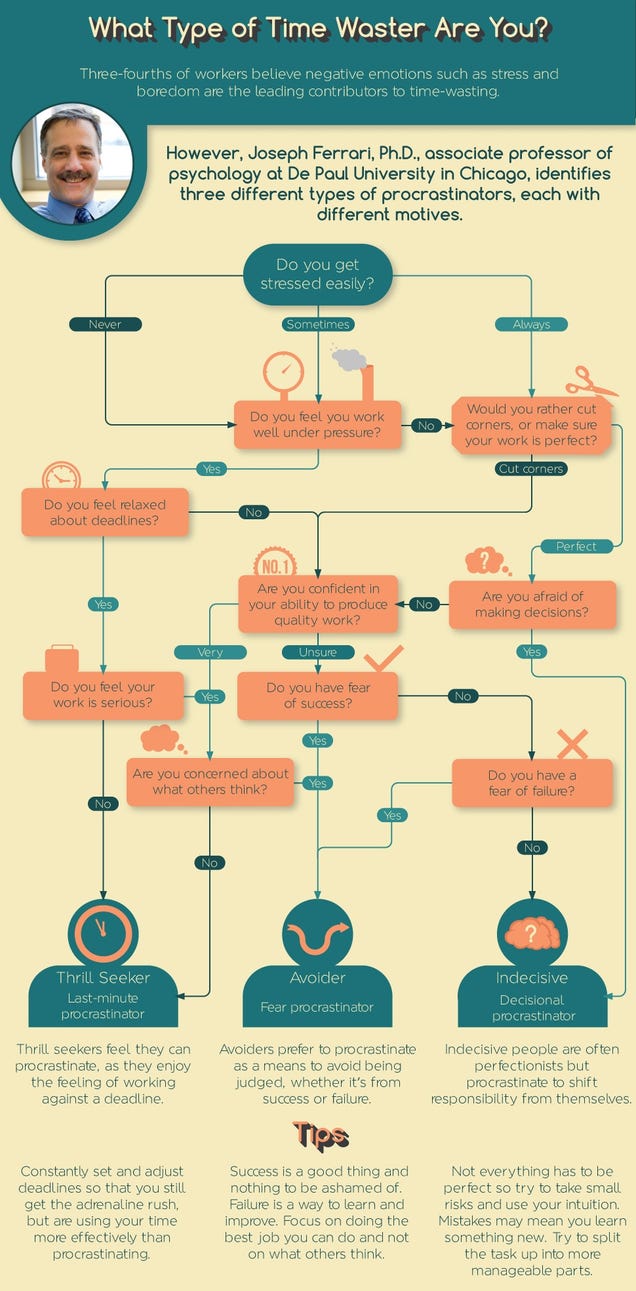
What Type of Procrastinator Are You?

Lifehacker has a useful flowchart from Dr. Joseph Ferrari of DePaul University, who has identified some basic types of procrastinators and identified solutions for each type.

Ferrari lists three procrastination archetypes:
  • Thrill Seekers, who say they do their best work under pressure and are "probably fooling themselves"
    • Solution: Complete a task ahead of time and "experience the thrill of finishing early"
  • Avoiders, who seek to avoid blame and potential judgment on their strengths and weaknesses
    • Solution: Keep a daily journal to help you challenge your thoughts
  • Indecisives, who are paralyzed by the potential consequences of decisions, both positive and negative
    • Solution: Keep the big picture in mind and move on once you've achieved your main goal.
It's a useful piece, and you'll likely recognize some of your own traits. (Your humble blogger, for example, is a classic Avoider.) Here's the infographic:

Thursday, May 15, 2014

What Do Employers Seek in New Hires?

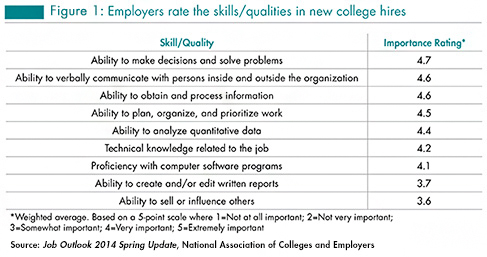
What are the most valuable skills and qualities to employers when they hire new employees? A new survey from the National Association of Colleges and Employers (NACE) has the answer.

According to NACE's Job Outlook 2014 Spring Update, employers are looking for candidates who are decisive, can solve problems, can communicate well and are analytical. "Ability to make decisions and solve problems," "Ability to verbally communicate with persons inside and outside the organization" and "Ability to obtain and process information" were rated as the most important skills.

NACE provided the following graphic showing the skills employers value the most:

Monday, October 15, 2012

What Makes a Great Boss?

That's the question Matthew Yglesias asks in a new Slate article. The impetus for the question is a working paper from Stanford University and University of Utah researchers called "The Value of Bosses" detailing research into supervisors at an unnamed company.

The researchers reached several conclusions, the most interesting of which is that much of the value of a good supervisor persists even after a worker switches bosses — that is, that a supervisor's greatest value comes from teaching effective work methods.

The paper also argues that pairing the best workers with the best supervisors, rather than having the best bosses mentor weaker workers, leads to increased productivity. Yglesias' article is a good entry point into a study that could have major implications for workplaces that implement its findings.

What makes a great boss to you? What did your best supervisors bring to the table?

Wednesday, July 11, 2012

Guest Blogger: Great by Choice

By John L. Daly, CPA, MBA, CMA, CPIM
President, Executive Education, Inc.

“Must Read” Research
In the “twenty-O’s” decade, many people called Good to Great by Jim Collins the new century’s best business book.  Backed by five years spent pouring over more than 30 years data, Collins provided page after page of insights into how a mediocre company can become great. 
Now, Collins, in collaboration with Harvard professor Morten T. Hansen, may provide this decade’s best business book, Great by Choice.  Backed by eight years of research, Great by Choice examines seven companies in turbulent industries that outperformed the U.S. stock market by at least ten fold (10x) for a 30 year period.  This book is a “must read” for anyone who wants to keep up on the latest management thinking.
10x Performance
As we would expect, the list includes some biotechnology and computer companies. However, a bigger surprise is that Southwest Airlines’ performance blows them all away, beating market performance by 63 times and more than tripling Intel’s stock performance. 
How could an airline thrive in such turbulent times?  Collins and Hansen conclude it was not innovation.  Southwest directly and deliberately copied Pacific Southwest Airlines (PSA).  Yet PSA eventually merged into U.S. Airways while Southwest thrived[1].  How did they do it? 
The research concludes the difference was discipline. 

Management Myths
Great by Choice dispels several entrenched management myths:
Myth:  Successful leaders in a turbulent world are bold risk-takers.
Reality:  Even the best leaders could not predict the future and avoided bold risks.  They were more disciplined, more empirical and more worried about how future events could hurt them. 
Myth:  Innovations distinguish 10x companies.
Reality:  10x companies were often less innovative than their lesser performing peers.
Myth:  A threat-filled world favors the speedy.
Reality:  Fast decisions and fast action can kill you faster.  10x leaders knew when to go fast and when not to. 
Myth:  Radical change in your environment requires radical change inside the company.
Reality:  10x companies believed most changes in their environment were just noise.  These companies studied issues carefully before making changes.
Myth:  Great companies have a lot more good luck.
Reality:  The 10x companies did not have unusual amounts of good luck.  However, they were much better prepared for bad luck than their peers. 
SMaC Recipe
The 10x companies developed what the authors call a SMaC recipe.  SMaC stands for Specific, Methodical and Consistent.  Like the core values which Collins and Jerry Porras found visionary companies had in their Built to Last research, SMaC recipes are standard operating procedures.  Unlike core values, the 10x companies sometimes changed their SMaC recipes.  However, they changed them far less than their mediocre-performing peers. 

Important Research
As you have seen in these few paragraphs, Collins and Hansen gained many new insights into business behavior, building on Collins previous research.  The sum of all business knowledge is rapidly growing.  Will you choose to keep up by reading Great by Choice?

John L. Daly, CPA, MBA, CMA, CPIM, is President of ExecutiveEducation, Inc. in Chelsea, Michigan.

[1] Some of the companies Collins profiled in Built to Last, Good to Great and Great by Choice later changed their management teams or management practices and no longer had great performance.  Collins discusses the reasons why in his 2009 book How the Mighty Fall. 

Monday, May 14, 2012

Embrace Your Weaknesses: The Laziness Paradox

When is confidence a bad thing? Productivity expert Scott Young has the answer in his blog post “The Laziness Paradox: Embrace Your Weaknesses to Accomplish More.”

Young gives the example of a friend who was overconfident in his ability to accomplish some ambitious fitness goals. He writes: “The weakness of confidence is when you’re forming concrete, short-term plans. These occur on such small timescales that you’re unlikely to reap any of the benefit of your inadvertent boasting, so being too ambitious can actually hurt you.”
He goes on to discuss how recognizing his weaknesses helped him change bad habits:

“For me, the biggest change in my life happened when I stopped trying to accomplish everything at once. I realized that I’m actually incredibly lazy—most of what I do has to do with habits and trivial stimuli, rather than deep thoughts.
“Instead of trying to change every behavior at once, I would pick something incredibly small and simple and focus on it for an entire month. Even that can be difficult, but it meant I could make a change almost habitual before I tried something else.”
So consider acknowledging your weaknesses when planning your schedule and tasks. You just might get more done.

Friday, May 4, 2012

Guest Blogger: What Makes a Great Workplace?

By Plum Cluverius
Vedere Consulting

You can hardly pick up a book or article on leadership these days without hearing how important the development of good relationships is to individual and organizational success. How do we know that’s true?
A number of research studies have identified the importance of relationships in successful workplaces, but a study often cited was conducted by the Gallup organization in the late 1990s. Gallup set out to discover the factors that separated organizations that were successful in finding, focusing and keeping talented employees from organization that didn’t have this competitive edge. When they began the study, Gallup researchers didn’t know if salaries or benefits or perks or leadership made the difference.

To find their measure of organizational effectiveness, Gallup turned to the over one million interviews they had conducted over a 25 year period. They had been measuring factors in the workplace that managers could control and that pointed to higher employee satisfaction. They were looking for patterns in these questions and they were particularly interested in teasing out the survey questions that loyal and engaged employees answered affirmatively but average or poor performers answered negatively or neutrally. The idea was to identify only the factors that appealed to highly motivated and talented employees.

When all was said and done and the factor analysis, regression analysis and concurrent validity studies were finished, 12 factors emerged from the data as the most important indicators of an organization’s ability to attract and retain the most talented employees. These factors are:
  1. Clear work expectations
  2. Equipment and materials to do job right
  3. Opportunity to “do what I do best” every day
  4. Recognition and praise (within the past seven days)
  5. Someone cares about me as a person
  6. Individual development and growth is encouraged
  7. My opinion is valued
  8. Company’s mission/purpose makes me feel my job is important
  9. Co-workers committed to quality work
  10. Close relationship at work
  11. Frequent conversations about progress
  12. Opportunities to learn and grow
What patterns do you notice when you look at these 12 factors? Clearly, a significant number are determined by the employee’s immediate boss and most of them require relationship building skills and focus. A manager is not going to be good at setting clear work expectations (which requires a conversation), knowing their employees’ strengths, demonstrating care and concern, connecting the work to the organization’s mission, and providing useful opportunities to learn if they cannot build trusting relationships or if they don’t take the time to build them.
Relationship building requires a level of self mastery — learning to bite your tongue until the right moment to have a difficult conversation. It requires self awareness — the ability to recognize your own emotions, observe them objectively and use them as clues to determine what you need from yourself and others. It requires empathy — the ability to recognize what others are feeling and to communicate understanding and acceptance in difficult times. Self mastery, self awareness and empathy are the cornerstones of emotional intelligence.

Emotional intelligence (EQ) is now identified as equally important to long term success as IQ. Fortunately, emotional intelligence can be learned. I encourage you to explore numerous articles and books on the topic to learn more. There are a number of good resources listed at my website, http://www.vedereconsulting.com/books.htm.

Plum Cluverius, PCC is an executive coach with over 30 years experience in leadership development. She lives and works in Richmond, Virginia. She writes a blog on leadership (used here) http://leadership-coach.vedereconsulting.com/.

Thursday, April 26, 2012

How to Craft Emails That Get Responses

Tired of writing emails that don’t get answers? Following a few guidelines and thinking of your communications in a different way can help you get better results.
The Art of Manliness says to treat each email as a pitch. Bloggers Brett and Kate McKay write, “What you’re pitching is the idea that you’re worth responding to — and that can be a tough sell.”
The McKays offer a list of tips for crafting your emails — some obvious, some less so:
  • Respect the recipient’s time and make sure the email is necessary
  • Begin with a salutation
  • Type your email address correctly in the contact form
  • Address the email to a specific person or people
  • Spell the recipient’s name right
  • Build rapport before getting down to business
  • Keep your email short and to the point
  • Make your request crystal clear
  • Don’t be a tease (be forthcoming with what you want and what you have to offer)
  • If you have a website, link to it
  • Don’t use ALL CAPS or all lowercase
  • Proofread and spell-check
  • Close with a valediction
  • Return the favor (do what you can to support their website or business)
  • Follow up (but only once!)
That blog entry links to another blog, Think Simple Now, with its own guidelines for effective emails. It’s important to put yourself in the shoes of the recipient, who likely “Gets a lot of email; may receive compliments regularly, if they are a public figure; regularly gets asked a standard set of questions and favors; does not have a lot of free time; does not mind helping you, if it is fast.”

That blog entry also contains a list of 15 tips for effective emails:
  • Determine your desired outcome
  • Quickly answer the question, “What’s the point?”
  • State benefits clearly
  • Remember to KISS (Keep It Simple, Stupid)
  • Stick to the facts
  • Pretend you’re involved in a face-to-face introduction
  • Imagine you’re sending a text message rather than an email
  • Avoid excessive compliments
  • Be personal and personable
  • Make it easy to be found
  • Use simple English
  • Use the correct font
  • Use proper, easy-to-read formatting
  • Minimize questions (and ask questions that truly matter)
  • Reread your email and trim unnecessary words before sending
What are your email pet peeves? What tactics are guaranteed to get you to hit “Reply” (or “Delete”)? Sound off in the comments.

Friday, April 6, 2012

How to Learn From Your Mistakes

While it may be painful, thinking about your mistakes can help you become more productive in the future. As John Caddell says at The 99 Percent, “Remember that everyone makes mistakes, but not everyone makes them worthwhile by using them to get better.”

Caddell suggests categorizing your mistakes to root out patterns, which he says often fall into one of three categories:
  • Sloppiness or carelessness
  • Playing to your weaknesses
  • Making errors under pressure
After identifying your patterns, Caddell suggests you decide on one specific action to help you address each one. Then you can decide how many of those things you can successfully implement. “It’s better to make one change that sticks than five changes that don’t,” Caddell advises.
Scott Berkun, meanwhile, suggests a different way of categorizing your mistakes by using the following categories. The examples are his:
  • Stupid (stubbing your toe)  
  • Simple (Having the power go out in the middle of your party because you didn’t pay the electric bill) 
  • Involved (Regularly arriving late for work) 
  • Complex (Making tough decisions that have bad results)
Berkun says that the involved mistakes require the most significant changes to correct. He and Caddell both say that acknowledging your mistakes is the first step toward correcting them. “If you can’t see the gaps, flaws, or weaknesses in your behavior you’re forever trapped in the same behavior and limitations you’ve always had,” Berkun says.

What techniques have worked for you to fix recurring mistakes?

Thursday, March 22, 2012

Ditch Your To-Do List for Greater Productivity

Productivity blogger Ari Meisel offers suggestions on his blog, Less Doing, for more efficient work. Two recent entries offer a suggestion that flies in the face of conventional wisdom — get rid of your to-do list.

Meisel’s thesis is that putting items on a static to-do list is a recipe for constant stress. He writes: “For a to do type task to be effective it has to disrupt your life at the appropriate time that you can get it done in the most efficient way but be completely out of sight and out of mind when it's no (sic) being worked on.”
Meisel suggests using email reminders as a way to organize your tasks, calling it “the task management version of carpe diem.” His email reminders are “the to do list evolved.”
Meisel also discusses the importance of timing rather than prioritization in organizing your life: “It would be foolish to think that simply arranging tasks in a pecking order will have any bearing on your productivity or your life tomorrow or even an hour from now. Obviously, it's important to think big picture when setting long term vision for a company or personal projects, but when it comes down to actually getting things done, we must live in the moment.”
He names followup.cc and HassleMe as email services to help you free yourself from the to-do list. Maybe ditching your to-do list isn’t an option, but email services could help you live a more stress-free existence.

Thursday, February 23, 2012

The Done Manifesto

Do you ever have trouble working on tight deadlines? Everyone deals with deadline pressure differently. A sense of urgency can be a double-edged sword — the deadline crunch can inspire you to new heights of productivity or wear you down mentally.
Bloggers Bre Pettis, co-founder of a robotics company, and Kio Stark developed the Done Manifesto to set guidelines for working on deadline. Naturally, they developed the rules on a 20-minute deadline. Here are the 13 guidelines of the Done Manifesto:
  1. There are three states of being. Not knowing, action and completion.
  2. Accept that everything is a draft. It helps to get it done.
  3. There is no editing stage.
  4. Pretending you know what you're doing is almost the same as knowing what you are doing, so just accept that you know what you're doing even if you don't and do it.
  5. Banish procrastination. If you wait more than a week to get an idea done, abandon it.
  6. The point of being done is not to finish but to get other things done.
  7. Once you're done you can throw it away.
  8. Laugh at perfection. It's boring and keeps you from being done.
  9. People without dirty hands are wrong. Doing something makes you right.
  10. Failure counts as done. So do mistakes.
  11. Destruction is a variant of done.
  12. If you have an idea and publish it on the internet, that counts as a ghost of done.
  13. Done is the engine of more.
Note that this advice doesn’t apply to a lot of tasks CPAs must do. If you’re doing a tax return or an audit, it doesn’t make sense to “laugh at perfection” or to count failure as done. It doesn’t do much good to finish a project in a haphazard way to get it off your plate for the time being — that strategy will come back to haunt you. But if you’re struggling with procrastination on projects outside of your comfort zone, the Done Manifesto can get you back in the working groove.

Wednesday, February 15, 2012

Brainstorming and Following Through

A recent article in The New Yorker traces the history of brainstorming from its genesis as an idea from an advertising executive in the 1940s. Jonah Lehrer’s story discusses brainstorming’s popularity before dropping this bombshell:
“But there is a problem with brainstorming. It doesn’t work.”

Lehrer, citing University of California-Berkeley psychology professor Charlan Nemeth, says that the standard “no criticism” brainstorming is ineffective because debate and criticism stimulate ideas, rather than inhibiting them. He goes on to discuss different theories on how employee interaction leads to better ideas.
While it’s true that bad ideas can lead to good ones, it’s important to look at those ideas with a critical eye. How does your firm’s brainstorming process work? What techniques have proven fruitful for you?

Tuesday, January 31, 2012

Learn to Triage Your Workload

Now that busy season has started, CPAs are practicing the yearly ritual of cramming untold amounts of work into their days. Finding the time to get your tasks done isn’t always easy or conducive to employee sanity.

So how do you prioritize your tasks to make sure the most important ones get done? Leadership expert Michael Hyatt has a six-step method:
  1. Acknowledge you can’t do it all
  2. Accept the fact some things won’t get done at all
  3. Practice workload triage
  4. Categorize your tasks by priority
  5. Practice intentional neglect
  6. Do the next most important thing next
This method won’t work for everyone — CPAs can’t let some clients slide during tax season. But is it effective in eliminating some less-important tasks from your workload? What methods do you use to ensure everything gets done?

Monday, January 23, 2012

Refine Your Networking Skills to Advance Your Career

Networking can help workers in any business, not just CPAs. Even if networking doesn’t result in an immediate job, the contacts you make can pay dividends down the road. At the CPA2Biz Career Insider, Debra Feldman offers four steps to becoming a better networker.

Feldman's four steps are:
  1. Establish strategic and personal networking expectations
  2. Set networking goals and objectives
  3. Target networking efforts to maximize results
  4. Use time judiciously and be respectful of others
For more networking tips, check out some other resources:

How to Network: For Introverts (Business Pundit)
Five Networking Tips for Wallflowers (Dumb Little Man)
7 Deadly Sins of Networking, and How to Avoid Them (Shine)

Wednesday, January 4, 2012

How to Reduce Stress in the New Year

Overloaded with work after the holiday break? If you are, you’re not alone. Many workers report a feeling of anxiety when they return to work after New Year’s. Some workplace productivity experts have advice for how to minimize that feeling.
At SmartPros, Jason Womack has several tips for overcoming that feeling of unease. “Most of your dread doesn’t come from the work itself — it comes from how you think about the work,” he says. Here are Womack’s tips for getting a handle on your 2012 workload:
  • Delete and recycle to make room for new work
  • Block out your time and focus on your most important tasks
  • Change how you manage your email
  • Maintain work/life balance by keeping work out of parts of your routine where it shouldn’t intrude
  • Be prepared to accomplish small tasks in your down time
  • Identify distractions that can torpedo your productivity
  • Divide your projects into manageable pieces
  • Organize your to-do list by verbs used to manage your productivity
  • Assess your performance each week
  • Forecast your future to organize your goals and accomplishments
For a more specific method of de-cluttering your life, check out Drew Olanoff’s tips at The Next Web. He offers several ways to organize your inbox with the goal of having ZERO unread emails.

Do you have any tried-and-true methods of decreasing stress and increasing productivity? Sound off in the comments.

Thursday, December 15, 2011

Advance Your Career by Developing 'Soft Skills'

So-called “soft skills” can make or break your relationship with your clients, particularly in a service industry like accounting. The Annapolis (Md.) Capital recently provided a rundown of the most important soft skills, with questions to ask yourself to help evaluate where you are:
  • Do you have a positive attitude?
  • Do you do what you say you will?
  • Are you respectful of other people’s time?
  • Are you proactive?
  • Do you show gratitude to people who help you?
  • Do you admit mistakes quickly and offer solutions?
  • Do you help others and work well with team members?
  • Do you communicate clearly verbally and in writing?
  • Do you listen carefully without interrupting?
  • Are you motivated to learn new skills?
  • How adaptable are you?
  • Do you avoid complaining?
  • Are you honest?
  • Do you persevere?
  • Are you creative?
By developing your soft skills, you can make yourself more attractive to clients and employers and provide a platform to let your professional talents shine through.

Tuesday, December 6, 2011

Many Workers Experience More Stress During the Holidays

Thirty-nine percent of workers surveyed by Accountemps say it's more challenging to manage their workloads during the holiday season.

For the survey, Accountemps interviewed 459 workers 18 years of age or older and employed in an office environment. When asked, "In general, is it more or less challenging to manage your workload during the holiday season?", 25 percent of respondents answered "Somewhat more challenging" and another 14 percent said "Much more challenging." Forty-four percent of respondents said there was no difference.

Workers were also asked, "Which of the following best describes your current professional workload?" Nearly half (47 percent) answered "Just right," while 29 percent indicated their workload was "Somewhat too heavy." Twelve percent answered "Much too heavy."

According to Accountemps Chairman Max Messmer, accounting and finance professionals can suffer particular challenges during the holiday season due to year-end close responsiblities and tax season preparation, among other factors.

Accountemps indicated five ways employers can help their employees manage end-of-year-workloads:
  • Support: Ensure staff have the resources needed to successfully complete their projects, including skilled temporary staff if necessary
  • Time: Encourage staff to leave early on a Friday or take an occasional long lunch to attend to non-work responsibilities
  • Flexibility: Offer flexible schedules or telecommuting options to help employees with work/life balance
  • Thanks: Express your appreciation to staff members for their work throughout the year
  • Fun: Close the year with a department celebration to build camaraderie