Monday, August 4, 2014

What Type of Procrastinator Are You?

Lifehacker has a useful flowchart from Dr. Joseph Ferrari of DePaul University, who has identified some basic types of procrastinators and identified solutions for each type.

Ferrari lists three procrastination archetypes:
  • Thrill Seekers, who say they do their best work under pressure and are "probably fooling themselves"
    • Solution: Complete a task ahead of time and "experience the thrill of finishing early"
  • Avoiders, who seek to avoid blame and potential judgment on their strengths and weaknesses
    • Solution: Keep a daily journal to help you challenge your thoughts
  • Indecisives, who are paralyzed by the potential consequences of decisions, both positive and negative
    • Solution: Keep the big picture in mind and move on once you've achieved your main goal.
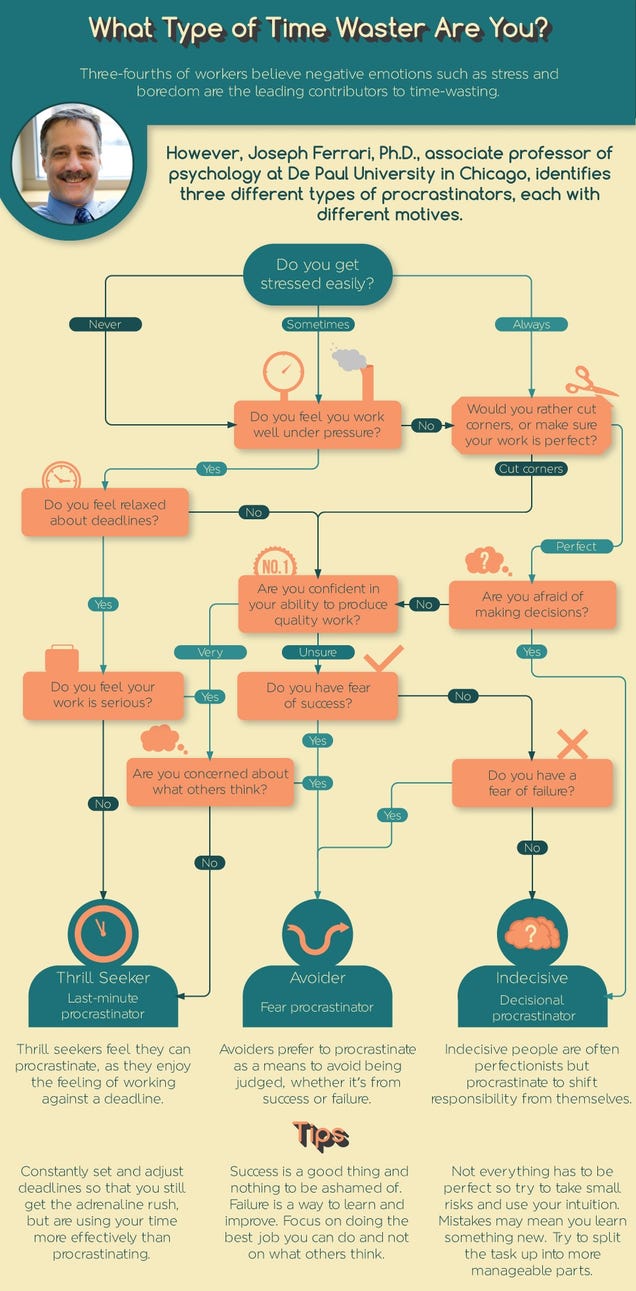
It's a useful piece, and you'll likely recognize some of your own traits. (Your humble blogger, for example, is a classic Avoider.) Here's the infographic:

Thursday, July 31, 2014

5 Reasons to Complete the MAP Survey Today!

The American Institute of CPAs' (AICPA) Insights blog has a great piece on the importance of the AICPA PCPS/TSCPA National MAP Survey, which closes today, July 31. Virginia is one of the states selected for the 2014 survey, so read on to learn about why you should hurry to take the survey today!

The five reasons the blog post gave were:
  1. Peer-to-peer comparisons, including key metrics broken down by firm size and geographic location
  2. The chance to redefine success by benchmarking it against local competition
  3. Benchmarking vital information for critical metrics
  4. A basis for crucial conversations, with one New Hampshire partner saying the survey "asks for just the right amount of information"
  5. An easy-to-use template for organizing internal information that you already have
Click here to start the survey now!

Wednesday, July 30, 2014

Study: 35 Percent of American Adults Have a Debt in Collections

According to a new study (PDF) from the Urban Institute, 35 percent of adults in the United States have a debt in collections reported in their credit history.

Nevada, which was hit hard by the mortgage crisis, topped the list with 47 percent of people who have a credit file having a debt in collections. The Silver State also had the highest average collections debt at $7,198.

Twelve other states and the District of Columbia also had more than 40 percent of adults with a credit file that reports a debt in collections. Aside from Nevada, the South was the hardest hit:
  • Alabama
  • Arkansas
  • Florida
  • Georgia
  • Kentucky
  • Louisiana
  • Mississippi
  • New Mexico
  • North Carolina
  • South Carolina
  • Texas
  • West Virginia
The Upper Midwest fared the best, with Minnesota and North and South Dakota reporting around 20 percent with reported debt in collections.

Among Virginia metropolitan statistical areas, Richmond had an average total debt of $62,323. Virginia Beach reported an average debt of $65,052, while the Washington metropolitan area had an average debt of $95,560.

Thursday, June 26, 2014

Starting Salary for 2014 Accounting Grads: $52,900

According to the latest salary survey from the National Association of Colleges and Employers (NACE), the average starting salary for 2014 graduates with business majors (including accounting) has declined slightly to $52,900.

That figure is down 0.8 percent from $53,300 in 2013. Business majors as a group will see an average starting salary of $53,901, an 0.6 percent decease from 2013.

The data was published in the April 2014 NACE Salary Survey.

Across all disciplines, the average starting salary for a new graduate with a bachelor's degree is up 1.2 percent to $45.473.

Wednesday, June 25, 2014

NACE: Nearly One-Third of Class of 2014 Graduates Had a Job at Graduation

According to the 2014 Student Survey from the National Association of Colleges and Universities (NACE), 30.1 percent of graduating college seniors from the class of 2014 who applied for a job had one in hand upon graduating, up 0.3 percent from the class of 2012 and 0.8 percent from the class of 2013.

Nearly half (47.9 percent) of graduating seniors had applied for a job and received at least one offer. Only 62.8 percent of those who had received a job offer had accepted an offer at the time of the survey.

Thursday, May 15, 2014

What Do Employers Seek in New Hires?

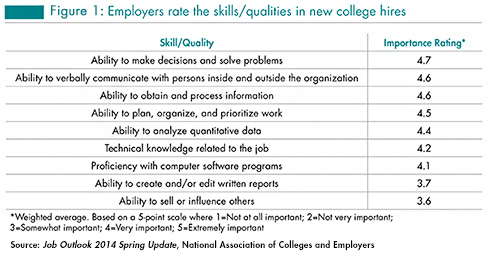
What are the most valuable skills and qualities to employers when they hire new employees? A new survey from the National Association of Colleges and Employers (NACE) has the answer.

According to NACE's Job Outlook 2014 Spring Update, employers are looking for candidates who are decisive, can solve problems, can communicate well and are analytical. "Ability to make decisions and solve problems," "Ability to verbally communicate with persons inside and outside the organization" and "Ability to obtain and process information" were rated as the most important skills.

NACE provided the following graphic showing the skills employers value the most:

Wednesday, April 23, 2014

IRS Releases 2014 List of Frivolous Tax Arguments

Do any of these look familiar? The U.S. Internal RevenueService (IRS) has released the 2014 version of “The Truth About Frivolous Tax Arguments,” which details and responds to some of the most common arguments from citizens who oppose federal tax laws.
 
“While taxpayers have the right to contest their tax liabilities, no one has the right to disobey the law or disregard their responsibility to pay taxes,” the agency said. “The penalty for filing a frivolous tax return is $5,000. The penalty is applied to anyone who submits a tax return or other specified submission, if any portion of the submission is based on a position the IRS identifies as frivolous.”
 
Included in the list are arguments that taxpayers can refuse to pay income taxes on religious or moral grounds and that federal employees are the only employees subject to federal income tax.
 
The IRS noted that those who promote or adopt frivolous tax positions could be responsible for one of several penalties, including:
  • Accuracy-related penalties
  • Civil fraud penalties
  • Erroneous refund claim penalties
  • Failure to file penalties
 
Taxpayers who make such arguments may also face criminal prosecution for attempting to evade tax.