According to the 2014 Student Survey from the National Association of Colleges and Universities (NACE), 30.1 percent of graduating college seniors from the class of 2014 who applied for a job had one in hand upon graduating, up 0.3 percent from the class of 2012 and 0.8 percent from the class of 2013.
Nearly half (47.9 percent) of graduating seniors had applied for a job and received at least one offer. Only 62.8 percent of those who had received a job offer had accepted an offer at the time of the survey.

Showing posts with label student feature. Show all posts
Showing posts with label student feature. Show all posts
Wednesday, June 25, 2014


Thursday, May 15, 2014
What Do Employers Seek in New Hires?
What are the most valuable skills and qualities to employers when they hire new employees? A new survey from the National Association of Colleges and Employers (NACE) has the answer.
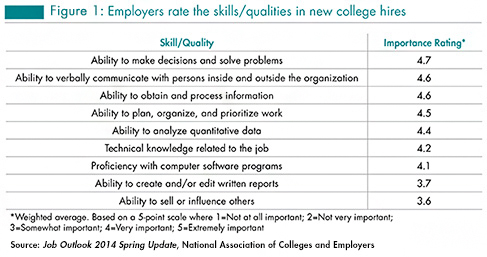
According to NACE's Job Outlook 2014 Spring Update, employers are looking for candidates who are decisive, can solve problems, can communicate well and are analytical. "Ability to make decisions and solve problems," "Ability to verbally communicate with persons inside and outside the organization" and "Ability to obtain and process information" were rated as the most important skills.
NACE provided the following graphic showing the skills employers value the most:
According to NACE's Job Outlook 2014 Spring Update, employers are looking for candidates who are decisive, can solve problems, can communicate well and are analytical. "Ability to make decisions and solve problems," "Ability to verbally communicate with persons inside and outside the organization" and "Ability to obtain and process information" were rated as the most important skills.
NACE provided the following graphic showing the skills employers value the most:
Monday, November 4, 2013
The Student's Perspective: An Unlikely Turn of Events
By Paul Fitzsimmons
President, Beta Alpha Psi, James Madison University
Editor's note: This is part of a series of guest posts from members of the James Madison University (JMU) chapter of Beta Alpha Psi, an honors fraternity for accounting students. These posts will cover topics of interest to accounting students. If you have a question you'd like a Beta Alpha Psi member to cover, please email VSCPA Communications Specialist Chip Knighton.
 Growing up, I always struggled with the question of what I wanted to be when I grew up. I could never quite picture myself as a businessman, let alone an accountant. Actually, the only thing I knew for sure was that I didn’t want to be an accountant. As far as I was concerned, anything else was a possibility. My dad is a CPA, and when I was younger I’d go into work with him occasionally. I remember thinking how boring it looked to have to sit in a desk all day and crunch numbers. This stereotype of the accounting profession is one that I think is shared by a lot of people and can deter otherwise potential CPAs from pursuing the career.
I entered JMU as a Justice Studies major; I thought being in the FBI would be pretty cool. It was only until I took my first Justice class that I quickly realized the major was not the path for me. In fact, the teacher emphasized the fact that the program at JMU was designed to be completely different from traditional criminal justice tracks. I began to peruse other majors but continued running into the same tough question- what did I want to be when I grew up?
I eventually made the decision to become a business major- marketing actually. My rationalization was that if by the end of my freshman year at JMU I still didn’t know what I wanted to do, I couldn’t go wrong with getting a business degree and figuring it out later. After all, everyone I knew who was a business major had been able to find pretty good jobs. As I embarked on the string of required pre-requisite classes for the College of Business, I had my first interaction with accounting. I was kind of dreading the class to be honest, with the stereotype of the work still fresh in my head.
I performed well in both of the introductory accounting classes and realized that there was way more to the profession than I thought. I remember doing some research and learning that accountants could become fraud examiners, do forensic investigations, and even help solve crimes. I was intrigued, and saw this as an opportunity to incorporate my interest in criminal justice with the accounting skillset I’d developed. I changed my major to accounting that spring. I would have never guessed I’d wind up as an accounting major, but what I’ve slowly learned over time is that the skillset you develop through the courses we take equips you with a marketable set of analytical skills that are transferrable to nearly any profession.
I had the opportunity to intern with Baker Tilly’s Consulting practice last summer in Mclean, VA, where I worked with the Government Contract Advisory Services team. I participated closely on a project that involved litigation support for a compliance infraction facing one of our client’s. I recently received an offer to join Ernst and Young’s Fraud Investigation and Dispute Services team in Washington, DC next summer. Among the services offered by the team are fraud investigations, litigation support, and data analytics. I have been able to take the skills I’ve learned in the classroom and pair them with career opportunities that I find fulfilling and challenging. My advice to any student in a similar position is to never let a stereotype cloud your judgment and prevent you from trying something new. I would have never guessed that I would wind up in accounting; however, the skills I’ve developed as a result have allowed me to find success in incorporating my personal interests into meaningful career opportunities.
President, Beta Alpha Psi, James Madison University
Editor's note: This is part of a series of guest posts from members of the James Madison University (JMU) chapter of Beta Alpha Psi, an honors fraternity for accounting students. These posts will cover topics of interest to accounting students. If you have a question you'd like a Beta Alpha Psi member to cover, please email VSCPA Communications Specialist Chip Knighton.
Growing up, I always struggled with the question of what I wanted to be when I grew up. I could never quite picture myself as a businessman, let alone an accountant. Actually, the only thing I knew for sure was that I didn’t want to be an accountant. As far as I was concerned, anything else was a possibility. My dad is a CPA, and when I was younger I’d go into work with him occasionally. I remember thinking how boring it looked to have to sit in a desk all day and crunch numbers. This stereotype of the accounting profession is one that I think is shared by a lot of people and can deter otherwise potential CPAs from pursuing the career.I entered JMU as a Justice Studies major; I thought being in the FBI would be pretty cool. It was only until I took my first Justice class that I quickly realized the major was not the path for me. In fact, the teacher emphasized the fact that the program at JMU was designed to be completely different from traditional criminal justice tracks. I began to peruse other majors but continued running into the same tough question- what did I want to be when I grew up?
I eventually made the decision to become a business major- marketing actually. My rationalization was that if by the end of my freshman year at JMU I still didn’t know what I wanted to do, I couldn’t go wrong with getting a business degree and figuring it out later. After all, everyone I knew who was a business major had been able to find pretty good jobs. As I embarked on the string of required pre-requisite classes for the College of Business, I had my first interaction with accounting. I was kind of dreading the class to be honest, with the stereotype of the work still fresh in my head.
I performed well in both of the introductory accounting classes and realized that there was way more to the profession than I thought. I remember doing some research and learning that accountants could become fraud examiners, do forensic investigations, and even help solve crimes. I was intrigued, and saw this as an opportunity to incorporate my interest in criminal justice with the accounting skillset I’d developed. I changed my major to accounting that spring. I would have never guessed I’d wind up as an accounting major, but what I’ve slowly learned over time is that the skillset you develop through the courses we take equips you with a marketable set of analytical skills that are transferrable to nearly any profession.
I had the opportunity to intern with Baker Tilly’s Consulting practice last summer in Mclean, VA, where I worked with the Government Contract Advisory Services team. I participated closely on a project that involved litigation support for a compliance infraction facing one of our client’s. I recently received an offer to join Ernst and Young’s Fraud Investigation and Dispute Services team in Washington, DC next summer. Among the services offered by the team are fraud investigations, litigation support, and data analytics. I have been able to take the skills I’ve learned in the classroom and pair them with career opportunities that I find fulfilling and challenging. My advice to any student in a similar position is to never let a stereotype cloud your judgment and prevent you from trying something new. I would have never guessed that I would wind up in accounting; however, the skills I’ve developed as a result have allowed me to find success in incorporating my personal interests into meaningful career opportunities.
Paul Fitzsimmons is a senior accounting major at James Madison University and Co-President of the Eta Delta chapter of Beta Alpha Psi. He will return to JMU next fall to embark on his Masters of Science in Accounting before starting full time work in the fall of 2015.
Wednesday, October 16, 2013
The Global Internship: Sightseeing in England
Editor's note: This is the latest in a series of blog posts from VSCPA student member Shannon Case (below), a graduate student at Virginia Commonwealth University (VCU). Look for more posts in the coming weeks detailing Shannon's experience as an intern in KPMG's London office.
By Shannon Case
KPMG
This past weekend was busy with plenty of sight-seeing in and around London. On Saturday I decided to take a day trip to Bath and Stonehenge. I woke up early and headed to Bath. After a 2 hour bus trip, I was surrounded by the beautiful city of Bath. The bus ride did not seem as long because I was busy snapping pictures of the English countryside. The city of Bath is so beautiful because all of the buildings are made of bath stone, which is pretty similar to limestone. In Bath I explored the Roman baths which were pretty amazing. After seeing the Roman baths, I walked around the city and had lunch. I explored the city a little more after lunch, took some great pictures, and then met back up with our tour group.
On Sunday I headed to Kensington Palace. On the way to the palace I came across a car show being held in Kensington Gardens. The show showcased 100 years of Aston Martins. It was really neat seeing a car for each year. They also had a special James Bond section! After seeing all of the cars, I explored Kensington Palace. I particularly enjoyed the Fashion Rules exhibit which had dresses on display from Princess Diana, Princess Margaret, and the Queen.
By Shannon Case
KPMG
This past weekend was busy with plenty of sight-seeing in and around London. On Saturday I decided to take a day trip to Bath and Stonehenge. I woke up early and headed to Bath. After a 2 hour bus trip, I was surrounded by the beautiful city of Bath. The bus ride did not seem as long because I was busy snapping pictures of the English countryside. The city of Bath is so beautiful because all of the buildings are made of bath stone, which is pretty similar to limestone. In Bath I explored the Roman baths which were pretty amazing. After seeing the Roman baths, I walked around the city and had lunch. I explored the city a little more after lunch, took some great pictures, and then met back up with our tour group.
On the way back to London my tour stopped
at Stonehenge. Stonehenge is one of the Seven Wonders of the World and it was
amazing to see. It was difficult to comprehend how these huge stones were moved
back in ancient times. They explained to us that it was believed that it took
approximately six hundred men to move a single large stone. After taking
photos, we headed back to London. Once I arrived back in London I had dinner
and went home and began to prepare for my next day of sightseeing.
On Sunday I headed to Kensington Palace. On the way to the palace I came across a car show being held in Kensington Gardens. The show showcased 100 years of Aston Martins. It was really neat seeing a car for each year. They also had a special James Bond section! After seeing all of the cars, I explored Kensington Palace. I particularly enjoyed the Fashion Rules exhibit which had dresses on display from Princess Diana, Princess Margaret, and the Queen.
After seeing Kensington I boarded a train
and headed toward Windsor Castle. As soon as I stepped off the train I could
see the castle. I initially explored the outside of the castle and the state
rooms. It was quite impressive! After leaving Windsor, I went home to rest my
aching feet...I did a lot of walking this weekend!
Thursday, October 3, 2013
The Global Internship: Living and Working in London
Editor's note: This is the latest in a series of blog posts from VSCPA student member Shannon Case (below), a graduate student at Virginia Commonwealth University (VCU). Look for more posts in the coming weeks detailing Shannon's experience as an intern in KPMG's London office.
By Shannon Case
KPMG
By Shannon Case
KPMG
I
absolutely loved living and working in London. My flat was located in Canary
Wharf which was a really convenient location for walking to work and also
exploring London. Canary Wharf is located on the Jubilee line which provides
great access to Westminster Abbey, Parliament, and other tourist attractions.
My flat was located within walking distance to our office. Every day I took a
foot bridge over the Thames which was quite nice. Canary Wharf is on a
peninsula so it’s surrounded by water and our balcony provides nice views all
the way around Canary Wharf.
This was my first time working and living
in a major city and I really enjoyed the experience. It was nice to be able to
walk to work and have so many shops so close to home. Underneath our building
was an underground mall which was connected to the tube. I also really liked
the KPMG building which is very new and modern with a lot of open space. The
building had a nice large cafeteria on the fifth floor which was also very
convenient.
Thursday, September 12, 2013
The Global Internship: Midnight in Paris
Editor's note: This is the latest in a series of blog posts from VSCPA student member Shannon Case (below), a graduate student at Virginia Commonwealth University (VCU). Look for more posts in the coming weeks detailing Shannon's experience as an intern in KPMG's London office.
By Shannon Case
KPMG
 As soon
as we got out of work, we hopped on a train and headed to Paris for
the weekend! As soon as our train got in
around midnight, we headed straight to the Eiffel Tower (hence the title
Midnight in Paris). A fellow global intern is doing a rotation in Paris, so we
thought it would be a great idea to visit him and share his place for the
weekend. He visited us the weekend before in London and we all had an amazing
time sightseeing together and sharing stories from our first weeks as interns
in different countries. We knew France would be celebrating Bastille Day, so we
thought it would be a great time to head to Paris.
As soon
as we got out of work, we hopped on a train and headed to Paris for
the weekend! As soon as our train got in
around midnight, we headed straight to the Eiffel Tower (hence the title
Midnight in Paris). A fellow global intern is doing a rotation in Paris, so we
thought it would be a great idea to visit him and share his place for the
weekend. He visited us the weekend before in London and we all had an amazing
time sightseeing together and sharing stories from our first weeks as interns
in different countries. We knew France would be celebrating Bastille Day, so we
thought it would be a great time to head to Paris.
On Saturday we went to Versailles which was one of the most gorgeous places I have ever visited in my life. The palace itself was magnificent, but I also loved the many gardens that surrounded the palace. At first we were unsure whether or not we would have enough time to go to Versailles, but I am so glad that we decided to go there. I would highly recommend it to anyone going to France. The Hall of Mirrors was one of my favorite places in the palace. I also loved the garden outside the Grand Trianon which was filled with white lilies and gorgeous views of the palace canals. It was a great day!
By Shannon Case
KPMG
As soon
as we got out of work, we hopped on a train and headed to Paris for
the weekend! As soon as our train got in
around midnight, we headed straight to the Eiffel Tower (hence the title
Midnight in Paris). A fellow global intern is doing a rotation in Paris, so we
thought it would be a great idea to visit him and share his place for the
weekend. He visited us the weekend before in London and we all had an amazing
time sightseeing together and sharing stories from our first weeks as interns
in different countries. We knew France would be celebrating Bastille Day, so we
thought it would be a great time to head to Paris. On Saturday we went to Versailles which was one of the most gorgeous places I have ever visited in my life. The palace itself was magnificent, but I also loved the many gardens that surrounded the palace. At first we were unsure whether or not we would have enough time to go to Versailles, but I am so glad that we decided to go there. I would highly recommend it to anyone going to France. The Hall of Mirrors was one of my favorite places in the palace. I also loved the garden outside the Grand Trianon which was filled with white lilies and gorgeous views of the palace canals. It was a great day!
On Sunday I spent the day exploring the
city of Paris. I decided to go to the Louvre and Notre Dame, but I also managed
to take a river tour on the Seine which was really nice. Touring on the river provides an entirely
different view and I managed to snap some great pictures. After a day of
sightseeing, I headed down to the Eiffel Tower and saw some fireworks and
enjoyed some great food for Bastille Day. Our trip to Paris was a great
experience and I definitely crossed many items off of my bucket list!
Monday, August 26, 2013
The Global Internship: My First Week as a KPMG Global Intern
Editor's note: This is the latest in a series of blog posts from VSCPA student member Shannon Case (below), a graduate student at Virginia Commonwealth University (VCU). Look for more posts in the coming weeks detailing Shannon's experience as an intern in KPMG's London office.
By Shannon Case
KPMG
 My first week as a KPMG global intern was challenging but also very rewarding. I had the opportunity to work directly under a partner which, while somewhat intimidating, offered me excellent experience and immediate exposure. The team here in London has been great about giving us work that is challenging and rewarding. It feels great knowing that my work is helping the firm to meet important client deadlines. My managers have been very helpful in explaining the work they need done and have provided us the resources to accomplish the tasks set before us.
After work we still have plenty of time to go out and explore London. It is such a great city with rich culture that offers an abundance of entertaining things to do. It is interesting to see how many Americans have moved here and now live and work in London. It is a great place to gain international experience without dealing with the challenges of speaking another language. Thinking back after this week, I am so grateful that I have had the chance to come to this amazing city and learn so much both at work and while sightseeing. I truly believe that travelling and experiences such as this internship help you grow not only professionally but also as an individual.
By Shannon Case
KPMG
My first week as a KPMG global intern was challenging but also very rewarding. I had the opportunity to work directly under a partner which, while somewhat intimidating, offered me excellent experience and immediate exposure. The team here in London has been great about giving us work that is challenging and rewarding. It feels great knowing that my work is helping the firm to meet important client deadlines. My managers have been very helpful in explaining the work they need done and have provided us the resources to accomplish the tasks set before us. After work we still have plenty of time to go out and explore London. It is such a great city with rich culture that offers an abundance of entertaining things to do. It is interesting to see how many Americans have moved here and now live and work in London. It is a great place to gain international experience without dealing with the challenges of speaking another language. Thinking back after this week, I am so grateful that I have had the chance to come to this amazing city and learn so much both at work and while sightseeing. I truly believe that travelling and experiences such as this internship help you grow not only professionally but also as an individual.
Friday, August 9, 2013
The Global Internship: Introduction
Editor's note: This is the first in a series of blog posts from VSCPA student member Shannon Case (below), a graduate student at Virginia Commonwealth University (VCU). Look for more posts in the coming weeks detailing Shannon's experience as an intern in KPMG's London office.
By Shannon Case
KPMG
 I knew early on in the recruiting process that I wanted to work for KPMG, but what I didn’t know was that in a few months they would be sending me on the trip of a lifetime! I first met KPMG when I attended a “Meet the Firms” event at Virginia Commonwealth University. I realized early on that I connected well with the firm and that it would be a great place to work. After only speaking with Pete Bartok, KPMG’s recruiter, for a few minutes, I felt as if I had known him much longer and by the end of our conversation, I was really excited about the thought of working for KPMG since I knew I’d fit in well there.
After securing a domestic internship in the Richmond office, I received an email regarding KPMG’s Global Internship Program (GIP). I recalled Pete mentioning this, and I thought it sounded like an incredible experience. I decided to apply for the GIP even though I knew the competition would be tough and honestly didn’t expect to be chosen. After completing the necessary requirements, which included an application and a written essay, I vividly remember screaming out loud when I found out that I was a finalist in the process. The next phase of the process consisted of a phone interview, which was pleasant and went very well. A few days later, I received a call that I would be heading to London for four weeks as a global intern! I will spend half of my internship in the Richmond, VA office and the other half in London. I am so looking forward to this amazing opportunity!
By Shannon Case
KPMG
I knew early on in the recruiting process that I wanted to work for KPMG, but what I didn’t know was that in a few months they would be sending me on the trip of a lifetime! I first met KPMG when I attended a “Meet the Firms” event at Virginia Commonwealth University. I realized early on that I connected well with the firm and that it would be a great place to work. After only speaking with Pete Bartok, KPMG’s recruiter, for a few minutes, I felt as if I had known him much longer and by the end of our conversation, I was really excited about the thought of working for KPMG since I knew I’d fit in well there.After securing a domestic internship in the Richmond office, I received an email regarding KPMG’s Global Internship Program (GIP). I recalled Pete mentioning this, and I thought it sounded like an incredible experience. I decided to apply for the GIP even though I knew the competition would be tough and honestly didn’t expect to be chosen. After completing the necessary requirements, which included an application and a written essay, I vividly remember screaming out loud when I found out that I was a finalist in the process. The next phase of the process consisted of a phone interview, which was pleasant and went very well. A few days later, I received a call that I would be heading to London for four weeks as a global intern! I will spend half of my internship in the Richmond, VA office and the other half in London. I am so looking forward to this amazing opportunity!
Monday, June 10, 2013
The Student's Perspective: Tax, Audit...or Other?
By Samantha Burch
Social Coordinator, Beta Alpha Psi, James Madison University
Editor's note: This is part of a series of guest posts from members of the James Madison University (JMU) chapter of Beta Alpha Psi, an honors fraternity for accounting students. These posts will cover topics of interest to accounting students. If you have a question you'd like a Beta Alpha Psi member to cover, please email VSCPA Communications Specialist Chip Knighton.
“Oh, you’re an Accounting major? Are you interested in tax or audit?”
 This question is one that every accounting student has encountered multiple times during his or her time in college. During the first two or three years of school, the answer is likely, “I’m not sure yet”, but by the time senior year rolls around, most of us have discovered which sector of accounting we fit into. Taking classes, participating in externships and internships, and talking with professionals in various lines of service provide valuable exposure to the sectors and can help you make the decision. However, an easy mistake for students to make is to believe that they are limited in choosing between audit and tax because these are usually the two most highlighted sectors. Students are presented with two general stereotypes: Tax professionals travel less, have less client interaction and have an intense busy season from January to April while audit professionals travel more frequently and have more extensive client interaction. Most people can easily identify with one of those descriptions over the other; but what happens if you are like me, and unable to imagine yourself in either line of service? What happens if you do not “fit”?
When someone asks me that question, I smile and reply, “Neither”. I will not yet say for certain what I am interested in, but I feel that neither tax nor audit is the right field for me. At first, this was concerning, and I wondered if I had chosen the right major at all. But with some research and the help of mentors, I discovered that there are a multitude of other opportunities to pursue, such as forensic accounting, accounting outsourcing, and consulting.
Fellow students, if you find yourself feeling less than enthusiastic about tax and audit, do not be discouraged. There are several steps you can take to conduct your own research and find your own perfect fit.
These steps may take a bit of extra effort, and additional time to explore everything that the accounting world has to offer. You may even feel downright maverick when someone asks you the dreaded audit/tax question. But it will have been worth it when you find your own personal niche.
Samantha Burch is a rising senior at JMU seeking a master's degree in forensic accounting. She is the social coordinator of the Eta Delta chapter of Beta Alpha Psi, as well as a student member of the VSCPA and a 2012 Leaders' Institute attendee. She works in JMU's financial reporting department and is currently interning with Robinson, Farmer, Cox Associates.
Social Coordinator, Beta Alpha Psi, James Madison University
Editor's note: This is part of a series of guest posts from members of the James Madison University (JMU) chapter of Beta Alpha Psi, an honors fraternity for accounting students. These posts will cover topics of interest to accounting students. If you have a question you'd like a Beta Alpha Psi member to cover, please email VSCPA Communications Specialist Chip Knighton.
“Oh, you’re an Accounting major? Are you interested in tax or audit?”
This question is one that every accounting student has encountered multiple times during his or her time in college. During the first two or three years of school, the answer is likely, “I’m not sure yet”, but by the time senior year rolls around, most of us have discovered which sector of accounting we fit into. Taking classes, participating in externships and internships, and talking with professionals in various lines of service provide valuable exposure to the sectors and can help you make the decision. However, an easy mistake for students to make is to believe that they are limited in choosing between audit and tax because these are usually the two most highlighted sectors. Students are presented with two general stereotypes: Tax professionals travel less, have less client interaction and have an intense busy season from January to April while audit professionals travel more frequently and have more extensive client interaction. Most people can easily identify with one of those descriptions over the other; but what happens if you are like me, and unable to imagine yourself in either line of service? What happens if you do not “fit”?When someone asks me that question, I smile and reply, “Neither”. I will not yet say for certain what I am interested in, but I feel that neither tax nor audit is the right field for me. At first, this was concerning, and I wondered if I had chosen the right major at all. But with some research and the help of mentors, I discovered that there are a multitude of other opportunities to pursue, such as forensic accounting, accounting outsourcing, and consulting.
Fellow students, if you find yourself feeling less than enthusiastic about tax and audit, do not be discouraged. There are several steps you can take to conduct your own research and find your own perfect fit.
- Talk to your professors. They are knowledgeable about different careers that you can access with an accounting degree. They also have contacts that can give you more information about areas that interest you.
- Know what concentrations or upper level classes universities offer before you choose which to attend for a graduate degree. Look for a place that offers a variety of courses unrelated to tax or audit so that you can sample them before you decide.
- Research accounting firms in your area that have service lines other than tax and audit. Apply for an externship program if they have one; chances are they will spend a portion of that time introducing you to the service lines you may not be familiar with. I recently participated in such an externship, where I discovered that accounting outsourcing greatly appeals to me.
- Look for firms that do rotational internships. This means that you will get to work in each of their lines of service during your internship. Real world experience is the best way for you to know whether you enjoy something or not because you will be doing it all day long, five days per week. Even if you do not fall in love with any particular service line, you may be able to rule one out.
These steps may take a bit of extra effort, and additional time to explore everything that the accounting world has to offer. You may even feel downright maverick when someone asks you the dreaded audit/tax question. But it will have been worth it when you find your own personal niche.
Samantha Burch is a rising senior at JMU seeking a master's degree in forensic accounting. She is the social coordinator of the Eta Delta chapter of Beta Alpha Psi, as well as a student member of the VSCPA and a 2012 Leaders' Institute attendee. She works in JMU's financial reporting department and is currently interning with Robinson, Farmer, Cox Associates.
Friday, May 10, 2013
The Student's Perspective: Landing the All-Important Internship
By Michael Gears
Vice President of Communications, Beta Alpha Psi, James Madison University
Editor's note: This is part of a series of guest posts from members of the James Madison University (JMU) chapter of Beta Alpha Psi, an honors fraternity for accounting students. These posts will cover topics of interest to accounting students. If you have a question you'd like a Beta Alpha Psi member to cover, please email VSCPA Communications Specialist Chip Knighton.

Vice President of Communications, Beta Alpha Psi, James Madison University
Editor's note: This is part of a series of guest posts from members of the James Madison University (JMU) chapter of Beta Alpha Psi, an honors fraternity for accounting students. These posts will cover topics of interest to accounting students. If you have a question you'd like a Beta Alpha Psi member to cover, please email VSCPA Communications Specialist Chip Knighton.
Graduating college is scary. Not only are my friends and I
about to finish their college career with
huge amounts of student loans, but
half of them are unable to find a job to start earning income and paying it
back. Luckily for us future CPAs, we often find ourselves deciding between job
offers, instead of hoping to receive one.
However, the recruiting process for accounting students still takes a
lot of effort, and I’d like to share with you a few things I’ve learned along
the way.
Many firms will host informational and casual meetings at a
local restaurant the night before they come for interviews. It’s very important
that candidates getting interviewed go to these. The most important thing at
these is that you make an effort to meet both the recruiter, and the person who
will be conducting the interview. If you are able to chat with them for a short
while, they will usually have a positive impression of you before you even sit
down for the interview. It will also separate you from other candidates who
didn’t show up, by proving that you are dedicated to the application process
and truly do want the position. Other key points for these events are to not
overstay your welcome, don’t bring up controversial topics, and don’t just go
with a friend and stick with them the whole time. This event is about meeting
the office employees on a personal level, so keep the conversation casual, but
keep in mind that this is still a very important part of the interview process,
and you will be judged on how you handle yourself.
Externships were a real eye-opening experience for my
recruiting process. These are short programs with firms that educate the
candidate more about the firm they might be interested in. I got a much better
feeling for the firms by doing these and seeing the working environment I would
be in. The recruiter describing the firm to you only can do so until you see
the actual office. Another benefit of these externships too is that you will
often get interviewed for internships with the firms, before any other
applicants do. The key on these externships is to really try and get a sense of
the culture of the firm, talk to as many employees as you’re able to meet. Just
like you had to picture yourself in the colleges you were applying for, you
have to see yourself fitting into the culture of the office. Externships are
the best place to do this.
If you’re lucky, your school might have mock interviews.
These are where actual recruiters will come in and interview you as if you were
applying for a job. The great benefit here though is they will critique you
afterwards and tell you where you need improvements, and review and edit your
resume that you bring in. Mock interview are great for sophomores to get out
some of the first interview jitters, or juniors and seniors to perhaps knock
some rust off. Professors and advisors can be great to get advice from, but the
ability to be critiqued by a recruiter actually in the current field provides a
whole different benefit.
As students, we are reinforced with the same tips constantly
for recruiting; introduce yourself, make sure to smile, a firm handshake.
However, there are a few pieces of original advice that I’ve learned along the
way through the recruiting process:
-
When wearing a name tag, make sure to wear it high on the right side of your chest. When you’re shaking somebody’s hand, it will be easier for them to maintain eye contact.
- If you choose to eat appetizers while meeting with firm personnel, always keep your shaking hand free. Keep a napkin under the plate you’re eating on to make cleaning your hands before shaking easier.
- Ask a few quality questions at the end of an interview. Some of my favorites are, why did you choose to work at this firm. What would be expected of me on my first year of working?
- The easiest and safest small talk conversations are usually over sports, family, hobbies, college experiences, and certainly the firm itself.
Don’t be afraid of what lies ahead. You chose a very
employable major and just need to polish yourself up a bit before hitting the
recruiting field. Follow these tips, get those A’s and you’ll be starting your
internship before you know it.
Michael Gears is an
accounting graduate student, concentrating in tax, at James
Madison University. He is the Vice President of Communications of the Eta
Delta chapter of Beta Alpha Psi and a student member of the VSCPA. He will be
interning at Veris Consulting this summer in Reston, VA.
Wednesday, April 3, 2013
The Student's Perspective: Decisions, Decisions ... Audit or Tax?
By Paul Hong
President, Beta Alpha Psi, James Madison University
Editor's note: This is part of a series of guest posts from members of the James Madison University (JMU) chapter of Beta Alpha Psi, an honors fraternity for accounting students. These posts will cover topics of interest to accounting students. If you have a question you'd like a Beta Alpha Psi member to cover, please email VSCPA Communications Specialist Chip Knighton.
 In the popular film The Matrix, Morpheus asks Keanu Reeves's character, Neo, to make a critical, life changing decision: either take the blue pill and go back to your normal fabricated life, or take the red pill, and face reality and save the world. Although not AS dramatic as this situation described, we as students preparing for the "real" world have some very essential decisions to make. For those of us in accounting, that can be directly related to choosing between careers in audit or tax.
Paul Hong is an accounting graduate student at James Madison University and president of the Eta Delta chapter of Beta Alpha Psi. He is a student member of the VSCPA. He has interned in the finance department at Minnieville Animal Hospital in Woodbridge. He chose audit.
President, Beta Alpha Psi, James Madison University
Editor's note: This is part of a series of guest posts from members of the James Madison University (JMU) chapter of Beta Alpha Psi, an honors fraternity for accounting students. These posts will cover topics of interest to accounting students. If you have a question you'd like a Beta Alpha Psi member to cover, please email VSCPA Communications Specialist Chip Knighton.
In the popular film The Matrix, Morpheus asks Keanu Reeves's character, Neo, to make a critical, life changing decision: either take the blue pill and go back to your normal fabricated life, or take the red pill, and face reality and save the world. Although not AS dramatic as this situation described, we as students preparing for the "real" world have some very essential decisions to make. For those of us in accounting, that can be directly related to choosing between careers in audit or tax.
For many students, the only exposure to the topics of audit and tax boil down to the experiences we have in a single audit class and a single tax class. So how do we make such a critical decision based on such limited information? The truth is, it is difficult to know whether audit or tax will be the best fit for any given person without actually having real-life experience in the field. Yet, there are still a few tips to help you make a more informed decision and decrease your chances of frowning behind the wrong desk.
1. Analyze your strengths and weaknesses
The first and most obvious step: pay attention in your audit and tax classes. You need to give both topics an equal chance and equal effort so that you will have a well-rounded view of each course to fairly assess your strengths and weaknesses. Don't just say, "There is no way I am doing tax it's so hard", which is something I have heard frequently, but actually give both a chance and don't let a difficult professor or grade make the choice for you. With that said, the majority of people will make their decision at this stage as they realize whether they are more inclined as a "tax person" or an "audit person".
2. Gain perspective
Ask as many questions to as many people as you can. You (or your parents) pay your professors to teach and prepare you for your careers so use them! Most of your professors have in-depth knowledge and personal experiences as tax and/or audit professionals. Next, especially for those of you in Beta Alpha Psi, come out to every professional event possible and delve into the minds of firm employees and their perspectives between audit and tax. But be wary, many people will have personal biases supporting their field of expertise so take the advice, thank them, and combine the different perspectives to compare similarities/differences and pros/cons in the responses you've received.
3. Apply for internships (rotational if offered)
You wouldn't marry a girl without meeting her first right? Well the best way to "date" a company and a certain position is by interning with them. You will get a quick glance at what life with the firm in that particular position would be like if you happen to join full-time. Also, if possible choose a rotational internship which allows interns to try out various positions in tax, audit, or IT/advisory so that they may have a glimpse into a variety of career paths.
4. Look for flexibility
The bottom line is firms want to make their employees happy. Seek out companies who are willing to be flexible with your career decisions. Worst comes to worse, you may realize you have made the wrong career decision and wish to switch from one position to another. If you follow this tip and initially join a flexible company, there should be no problem. They would be more than happy to accommodate your needs as long as you are a strong performer. Keep them happy and they will make you happy.
5. Identify what personally fits YOU best
Here are a few very basic and GENERALIZED differences I have learned about between audit and tax for entry level positions:
Audit: majority of time spent at client-site, more travel, shared personal desks and area, more client interaction, more team work, client interaction not completely positive (no biases or offense intended)
Tax: majority of time spent in company office, less travel, own personal desks and area, less client interaction, less team work, client interaction slightly more positive (no biases or offense intended)
In closing, I believe a tax partner I spoke with at Ernst & Young said it best, "Tax is like driving a car forward planning for what is ahead, while audit is like looking in the rear view mirror and checking on what was behind."Paul Hong is an accounting graduate student at James Madison University and president of the Eta Delta chapter of Beta Alpha Psi. He is a student member of the VSCPA. He has interned in the finance department at Minnieville Animal Hospital in Woodbridge. He chose audit.
Tuesday, March 5, 2013
The Student's Perspective: Firm Campus Visits
What Do Students Expect When Firms Visit College Campuses?
By Michael Thiele
President, Beta Alpha Psi, James Madison University
Editor's note: This is the first in a series of guest posts from members of the James Madison University (JMU) chapter of Beta Alpha Psi, an honors fraternity for accounting students. These posts will cover topics of interest to accounting students.
 The first and foremost item I look for when firms
visit campus is a solid presentation. When a firm comes and gives a
well-planned, well-rehearsed, engaging presentation it shows that they are
serious about hiring and are really aiming to impress. At some point during the
presentation I am also looking for the firm to provide a cultural overview of
their company. This may be the most important area that the firm can cover. If
we as students are going to be spending the next chapter of our lives at this
company, we want to know that the culture there will coagulate with our own.
Immediately following that should be what sets their firm apart from other
similar firms. It is no mystery that many public accounting firms do very
similar work, but what we really want to know is, “what makes your firm so
special?” Many of the firms that visit highlight their financial success and
awards they have won which is nice, but what we are really looking for is that
special trait that sets their firm apart from the rest. Whether it be jean
Fridays or paid time for community service, certain attributes attract
different people and highlighting them is critical to picking the right future
employees. Another area where firms can set themselves apart from the others is
highlighting their work-life balance initiatives. We have all heard by now that
public accounting may not be the most stress free profession at times so
hearing what firms do to balance out the work can be a deciding factor.
The first and foremost item I look for when firms
visit campus is a solid presentation. When a firm comes and gives a
well-planned, well-rehearsed, engaging presentation it shows that they are
serious about hiring and are really aiming to impress. At some point during the
presentation I am also looking for the firm to provide a cultural overview of
their company. This may be the most important area that the firm can cover. If
we as students are going to be spending the next chapter of our lives at this
company, we want to know that the culture there will coagulate with our own.
Immediately following that should be what sets their firm apart from other
similar firms. It is no mystery that many public accounting firms do very
similar work, but what we really want to know is, “what makes your firm so
special?” Many of the firms that visit highlight their financial success and
awards they have won which is nice, but what we are really looking for is that
special trait that sets their firm apart from the rest. Whether it be jean
Fridays or paid time for community service, certain attributes attract
different people and highlighting them is critical to picking the right future
employees. Another area where firms can set themselves apart from the others is
highlighting their work-life balance initiatives. We have all heard by now that
public accounting may not be the most stress free profession at times so
hearing what firms do to balance out the work can be a deciding factor.
Aside from the general overview of the firm, students also like hearing certain specific key details such as the types of clients the firm deals with. While none of us have experienced firsthand what it is like to deal with different types of clients, some people may be particularly interested in working with federal or non-profit clients as opposed to huge public companies and vice versa. Thus, it is important to showcase what industries the firm is associated with.
Other key details that must be conveyed to student include credentials needed for hiring as well as the general interview process. Firms need to let students know what criteria they must meet for employment for the student’s sake as well as their own. This can save a tremendous amount of time on both ends as students won’t apply for a position where they clearly don’t meet the requirements. An overview of the interview process is also important so that students have time to rearrange their class schedules and such. This is especially important if the firm conducts office visits at locations far away from campus. Giving the students a heads up about the process can also take some of the anxiety away which allows the interviewer to get a better assessment of the interviewee.
Finally, in my opinion, the most critical question that a recruiter can answer is, “why did you choose to work there?” The answer to this question reveals more than you can imagine because it puts the recruiter on the spot and often forces them to give a genuine, sincere answer. Many recruiters will say they chose their firm because of the people. While this is a good answer, a better answer would be to go into detail as to why the people at your firm are different from others.
All in all, it is important to be thorough while still keeping the audience engaged. The recruiters should act in a professional manner but be approachable at the same time. Putting all these elements together fits the description of a perfect visit to campus.
Michael Thiele is a senior accounting major at James Madison University and president of the Eta Delta chapter of Beta Alpha Psi. He is a student member of the VSCPA and the New Jersey Society of CPAs (NJSCPA). He has interned at Fannie Mae and KPMG.
By Michael Thiele
President, Beta Alpha Psi, James Madison University
Editor's note: This is the first in a series of guest posts from members of the James Madison University (JMU) chapter of Beta Alpha Psi, an honors fraternity for accounting students. These posts will cover topics of interest to accounting students.
The first and foremost item I look for when firms
visit campus is a solid presentation. When a firm comes and gives a
well-planned, well-rehearsed, engaging presentation it shows that they are
serious about hiring and are really aiming to impress. At some point during the
presentation I am also looking for the firm to provide a cultural overview of
their company. This may be the most important area that the firm can cover. If
we as students are going to be spending the next chapter of our lives at this
company, we want to know that the culture there will coagulate with our own.
Immediately following that should be what sets their firm apart from other
similar firms. It is no mystery that many public accounting firms do very
similar work, but what we really want to know is, “what makes your firm so
special?” Many of the firms that visit highlight their financial success and
awards they have won which is nice, but what we are really looking for is that
special trait that sets their firm apart from the rest. Whether it be jean
Fridays or paid time for community service, certain attributes attract
different people and highlighting them is critical to picking the right future
employees. Another area where firms can set themselves apart from the others is
highlighting their work-life balance initiatives. We have all heard by now that
public accounting may not be the most stress free profession at times so
hearing what firms do to balance out the work can be a deciding factor. Aside from the general overview of the firm, students also like hearing certain specific key details such as the types of clients the firm deals with. While none of us have experienced firsthand what it is like to deal with different types of clients, some people may be particularly interested in working with federal or non-profit clients as opposed to huge public companies and vice versa. Thus, it is important to showcase what industries the firm is associated with.
Other key details that must be conveyed to student include credentials needed for hiring as well as the general interview process. Firms need to let students know what criteria they must meet for employment for the student’s sake as well as their own. This can save a tremendous amount of time on both ends as students won’t apply for a position where they clearly don’t meet the requirements. An overview of the interview process is also important so that students have time to rearrange their class schedules and such. This is especially important if the firm conducts office visits at locations far away from campus. Giving the students a heads up about the process can also take some of the anxiety away which allows the interviewer to get a better assessment of the interviewee.
Finally, in my opinion, the most critical question that a recruiter can answer is, “why did you choose to work there?” The answer to this question reveals more than you can imagine because it puts the recruiter on the spot and often forces them to give a genuine, sincere answer. Many recruiters will say they chose their firm because of the people. While this is a good answer, a better answer would be to go into detail as to why the people at your firm are different from others.
All in all, it is important to be thorough while still keeping the audience engaged. The recruiters should act in a professional manner but be approachable at the same time. Putting all these elements together fits the description of a perfect visit to campus.
Michael Thiele is a senior accounting major at James Madison University and president of the Eta Delta chapter of Beta Alpha Psi. He is a student member of the VSCPA and the New Jersey Society of CPAs (NJSCPA). He has interned at Fannie Mae and KPMG.
Thursday, August 25, 2011
VSCPA Student Feature: Accounting Students Speak Up
The Virginia Society of CPAs (VSCPA) caught up with six top Virginia accounting students and quizzed them about their college experience and career goals via email. Here’s a little information about our panel:
Katherine Covino, 21
The College of William & Mary
2011–2012 F. Wilson Brown Scholarship recipient
Hometown: Chantilly
Expected graduation date: Spring 2012
Major: Accounting
Adrienne Essiaw, 20
The College of William & Mary
2011–2012 VSCPA Minority Scholarship recipient
Hometown: Warrenton
Expected graduation date: Spring 2012
Major: Accounting with concentration in Finance
Kelly Miller, 21
Lynchburg College
2011–2012 VSCPA Undergraduate Scholarship recipient
Hometown: Charlottesville
Expected graduation date: Spring 2012
Major: Accounting
Becky Perron, 22
University of Virginia
2011–2012 Yount Hyde & Barbour Scholarship recipient
Hometown: Williamsburg
Expected graduation date: Winter 2011 (Master’s degree)
Major: M.S. in Accounting
Fatima Sbai, 34
George Mason University
2011–2012 VSCPA Minority Scholarship recipient
Hometown: Alexandria
Expected graduation date: Spring 2013
Major: Accounting
Why did you decide to pursue a degree in accounting?
Katherine Covino: I thought that accounting was one of the most valuable business majors that was offered. Accounting provides students with a background that enables them to work in any area of business, because as long as you understand what is happening in the background with the numbers, you can be successful in any business venture.
Adrienne Essiaw: I was always interested in business, and when I became a junior in high school, I enrolled in an introductory accounting class. A week into my first business class, I knew that I wanted to get into the field of accounting. I was intrigued by the fact that accounting represented the language of business and explained the overall processes of our everyday financial transactions. After doing some research and speaking to several advisers and faculty members, I discovered that the career options for an accountant were limitless.
Kelly Miller: I have always liked working with numbers. It is something I just understand. As I grew older, I enjoyed keeping my checkbook, helping people budget. I always knew I wanted to be in the business field as a career. I took a class in accounting my freshmen year in college and loved it. I cruised through it, I just got it. It was something I could see myself doing for the rest of my life.
Becky Perron: I had trouble finding one interest to pursue in college, but as soon as I began to take accounting classes, it clicked. After I completed my internship and realized that accounting was more than simply crunching numbers, I knew it was the right place to start for me.
Fatima Sbai: As a mother and an older student, I was looking for a career that will allow me to have a flexible schedule to spend time with my family. I also wanted a career challenging enough to keep me interested.
What are your career goals?
KC: In the short term, I hope to secure a full time job before graduation. My long term goal is to eventually become a partner at one of the Big Four accounting firms.
AE: After completing a master’s degree in accounting, I will prepare for the CPA Exam in hopes of becoming more qualified in the field of accounting. I would like to work for an accounting firm that offers various lines of services such as assurance, tax, and advisory. Given the opportunity to work at a firm that offers many services for their clients, I will be able to expand my knowledge in areas of accounting that may differ from what I would specialize in.
Ultimately, I hope to be able to give back to others in the form of guidance and mentoring. I would like to develop a mentoring program for young women who are interested in pursuing a career in business, but may not have the resources or individuals in their lives to make it possible. I believe that if someone is passionate about what they want to do, and have the right people around to encourage them to follow through with their goals, nothing is out of reach.
KM: I plan to become a CPA and CMA [Certified Management Accountant] after graduation. I want to start in the public sector of accounting and possibly move to the private side further in my future.
BP: I plan to start in public accounting with KPMG in January of 2012. Whether or not I stay in public accounting forever, I know that I want to make a difference in whatever I am doing. As long as I am being challenged and feel like my work is somehow helping others, I will be happy.
FS: My ultimate career goal is to have my own firm and expand it to North Africa. For my immediate goals, I am planning to work the first 10 years after graduation, for one of the Big Four as well as a regional firm. This will give me a broader view and the experience to advance in the accounting profession.
Do you plan to sit for the CPA Exam?
KC: Absolutely! I plan to sit for the CPA Exam next summer and hopefully pass all four sections the first time around. I think that many opportunities will come my way as a CPA.
AE: Yes, I plan to sit for the exam after I complete my Master’s of Accounting in spring 2013.
KM: Yes, without a doubt!
BP: Yes, I am currently spending my summer studying and sitting for the CPA Exam. There are no post-graduation vacations here! I took a Becker FastPass course at William & Mary and sat for my first section this past Friday [July 8]. The other three are scheduled periodically throughout the remainder of the summer.
FS: Absolutely. I plan to sit for the CPA Exam right after a master's degree in accounting.
What has been the biggest challenge in your accounting education?
KC: My biggest challenge was a research project that I participated in for one of my accounting classes this past spring. Accounting research projects are a lot of work and can be very frustrating at times, but they do produce some very important insights.
AE: The biggest challenge in my accounting education has been trying to come to terms with the fact that there is not always a correct answer.
You cannot approach accounting with the idea that there is only one way to do things. Accounting is somewhat subjective and is constantly changing. As an accounting student, I have been pushed by professors to provide the reasoning behind all of my conclusions, whether or not there was a correct answer. This skill will become very useful when trying to solve accounting problems that may be unique to specific users of financial information.
KM: The biggest challenge I've had in my accounting career has been pushing through the upper-level classes when things seem to get a little more challenging. As hard as it may be, sometimes it is always a very rewarding payoff.
BP: The McIntire [School of Commerce] business program puts a lot of emphasis on teamwork and we complete two semester-long team projects during our third year. Learning how to work with people with different work ethics, styles and motivations was the most challenging part of my undergraduate education. Nevertheless, I believe I learned a lot from that semester that I can take with me when I enter the workforce.
FS: My biggest challenge in my accounting education is the lack of time to network with potential employers. To build a network, it is essential for accounting students to stay visible by taking parts in career fairs and school activities outside the classroom. This is challenging for me because I commute to GMU. If I am not in class or at the library, I am most likely on the road or at home helping my daughter with her homework.
What are your proudest accomplishments?
KC: In the academic world, my proudest accomplishments include being selected as a VSCPA Scholarship winner and helping other William & Mary students revamp the Wayne F. Gibbs Accounting Society. Outside of academics, I am very pleased that I secured a summer internship and that I will be serving on the Executive Board for the Alan J. Bukzin Bone Marrow Drive.
AE: My proudest accomplishments are getting accepted into The College of William & Mary and being inducted into the International Honor Society, Beta Gamma Sigma. As a child, I knew that William & Mary was a historic institution with an outstanding academic reputation, but I never imagined I would be able to get into such a school. My academic journey was not always easy, as I struggled with English after having lived in Ghana for a few years as a child. I was able to overcome the language barrier with the unconditional love and support of my family.
When I was accepted into William & Mary, it was a blessing for my family and I. The opportunity to go onto college not only represented an opportunity to further my education, but also a chance to take advantage of the privilege of being able to receive an education which many are denied due to their life circumstances.
Throughout my life, and especially in college, my parents have been my main source of inspiration. Nothing makes me happier, than to know that my parents are proud of the person I have become. Getting inducted into the International Honor Society, Beta Gamma Sigma, is a great accomplishment that comes with the lifelong commitment of personal and professional excellence, as well as the advancement in the values of society. When I was inducted into Beta Gamma Sigma, I was not only humbled and honored to be a part of such a distinguished honor society, but happy to know that I had made my parents proud. I hope to contribute to Beta Gamma Sigma's mission by living a personal and professional life that reflects the values my parents have instilled in me and applying that to the advancement of society.
KM: My proudest accomplishments are: making the Dean's List four of my six semesters so far at LC, sticking with accounting when I started to second-guess myself when an intermediate became challenging, and being invited to the VSCPA's Leaders' Institute as a rising junior last summer at Virginia Tech and being selected to attend the Dixon Hughes Goodman Learn Grow Go Leadership Conference this summer!
BP: One of my proudest accomplishments is completing my first marathon during my third year at UVa. I have since completed another and am training for my third, but I will always remember crossing the finish line for the first time. It took a lot of time and effort during training to get up early and get the miles in. Another would be simply graduating from UVa. I still can't believe that the four years went by this fast. I am also looking forward to being able to say that one of my proudest accomplishments is becoming a CPA!
FS: My proudest accomplishment is getting my associate’s degree in business administration with a 4.0. I am also proud to say that I passed my first accounting class with a perfect score in all exams.
What advice would you offer prospective accounting students?
KC: I recommend sitting down and looking at all the CPA requirements before your senior year of college. It is important to decide how you want to obtain the 150-credit hour requirement. Do you want to attend a Master’s of Accounting program, or do you want to do a summer session? It is really up to the student to determine how they want to achieve the 150 credit hours, but it is often difficult to achieve if students wait until it is too late.
AE: If you have the slightest interest in accounting, I recommend taking an introductory course to see if this is something you may be interested in. Accounting is such a broad field that you can do so much with, and you may not realize that until you have invested the time to learn more about the field and the opportunities that are available for accounting majors. If accounting does not come easy for you, that does not mean you cannot be an accounting major. With the right attitude, work ethic and drive, you can accomplish anything in life. It is also important to surround yourself with mentors, friends and individuals who encourage you and push you to reach your greatest potential.
KM: The best advice I would give accounting students is read and do your homework. Also, stick with it ... if you enjoy it, even just a little, it is a wonderful profession to go into!
BP: Remember to work hard, do lots of practice problems, and don't forget the importance of people skills in accounting! The best thing I did during my internship was be helpful, hardworking and personable. Also ask questions if you don't understand. No one should be expected to know everything.
FS: My advice would be not be intimidated by accounting. Some students think that they have to be good at mathematics in order to succeed in accounting. While an analytical mindset is a plus, being great at calculus is not a prerequisite. I saw some students give up quickly. Students should take full advantage of any tutoring sessions that schools often provide for free.
Katherine Covino, 21
The College of William & Mary
2011–2012 F. Wilson Brown Scholarship recipient
Hometown: Chantilly
Expected graduation date: Spring 2012
Major: Accounting
The College of William & Mary
2011–2012 VSCPA Minority Scholarship recipient
Hometown: Warrenton
Expected graduation date: Spring 2012
Major: Accounting with concentration in Finance
Lynchburg College
2011–2012 VSCPA Undergraduate Scholarship recipient
Hometown: Charlottesville
Expected graduation date: Spring 2012
Major: Accounting
University of Virginia
2011–2012 Yount Hyde & Barbour Scholarship recipient
Hometown: Williamsburg
Expected graduation date: Winter 2011 (Master’s degree)
Major: M.S. in Accounting
George Mason University
2011–2012 VSCPA Minority Scholarship recipient
Hometown: Alexandria
Expected graduation date: Spring 2013
Major: Accounting
Why did you decide to pursue a degree in accounting?
Katherine Covino: I thought that accounting was one of the most valuable business majors that was offered. Accounting provides students with a background that enables them to work in any area of business, because as long as you understand what is happening in the background with the numbers, you can be successful in any business venture.
Adrienne Essiaw: I was always interested in business, and when I became a junior in high school, I enrolled in an introductory accounting class. A week into my first business class, I knew that I wanted to get into the field of accounting. I was intrigued by the fact that accounting represented the language of business and explained the overall processes of our everyday financial transactions. After doing some research and speaking to several advisers and faculty members, I discovered that the career options for an accountant were limitless.
Kelly Miller: I have always liked working with numbers. It is something I just understand. As I grew older, I enjoyed keeping my checkbook, helping people budget. I always knew I wanted to be in the business field as a career. I took a class in accounting my freshmen year in college and loved it. I cruised through it, I just got it. It was something I could see myself doing for the rest of my life.
Becky Perron: I had trouble finding one interest to pursue in college, but as soon as I began to take accounting classes, it clicked. After I completed my internship and realized that accounting was more than simply crunching numbers, I knew it was the right place to start for me.
Fatima Sbai: As a mother and an older student, I was looking for a career that will allow me to have a flexible schedule to spend time with my family. I also wanted a career challenging enough to keep me interested.
What are your career goals?
KC: In the short term, I hope to secure a full time job before graduation. My long term goal is to eventually become a partner at one of the Big Four accounting firms.
AE: After completing a master’s degree in accounting, I will prepare for the CPA Exam in hopes of becoming more qualified in the field of accounting. I would like to work for an accounting firm that offers various lines of services such as assurance, tax, and advisory. Given the opportunity to work at a firm that offers many services for their clients, I will be able to expand my knowledge in areas of accounting that may differ from what I would specialize in.
Ultimately, I hope to be able to give back to others in the form of guidance and mentoring. I would like to develop a mentoring program for young women who are interested in pursuing a career in business, but may not have the resources or individuals in their lives to make it possible. I believe that if someone is passionate about what they want to do, and have the right people around to encourage them to follow through with their goals, nothing is out of reach.
KM: I plan to become a CPA and CMA [Certified Management Accountant] after graduation. I want to start in the public sector of accounting and possibly move to the private side further in my future.
BP: I plan to start in public accounting with KPMG in January of 2012. Whether or not I stay in public accounting forever, I know that I want to make a difference in whatever I am doing. As long as I am being challenged and feel like my work is somehow helping others, I will be happy.
FS: My ultimate career goal is to have my own firm and expand it to North Africa. For my immediate goals, I am planning to work the first 10 years after graduation, for one of the Big Four as well as a regional firm. This will give me a broader view and the experience to advance in the accounting profession.
Do you plan to sit for the CPA Exam?
KC: Absolutely! I plan to sit for the CPA Exam next summer and hopefully pass all four sections the first time around. I think that many opportunities will come my way as a CPA.
AE: Yes, I plan to sit for the exam after I complete my Master’s of Accounting in spring 2013.
KM: Yes, without a doubt!
BP: Yes, I am currently spending my summer studying and sitting for the CPA Exam. There are no post-graduation vacations here! I took a Becker FastPass course at William & Mary and sat for my first section this past Friday [July 8]. The other three are scheduled periodically throughout the remainder of the summer.
FS: Absolutely. I plan to sit for the CPA Exam right after a master's degree in accounting.
What has been the biggest challenge in your accounting education?
KC: My biggest challenge was a research project that I participated in for one of my accounting classes this past spring. Accounting research projects are a lot of work and can be very frustrating at times, but they do produce some very important insights.
AE: The biggest challenge in my accounting education has been trying to come to terms with the fact that there is not always a correct answer.
You cannot approach accounting with the idea that there is only one way to do things. Accounting is somewhat subjective and is constantly changing. As an accounting student, I have been pushed by professors to provide the reasoning behind all of my conclusions, whether or not there was a correct answer. This skill will become very useful when trying to solve accounting problems that may be unique to specific users of financial information.
KM: The biggest challenge I've had in my accounting career has been pushing through the upper-level classes when things seem to get a little more challenging. As hard as it may be, sometimes it is always a very rewarding payoff.
BP: The McIntire [School of Commerce] business program puts a lot of emphasis on teamwork and we complete two semester-long team projects during our third year. Learning how to work with people with different work ethics, styles and motivations was the most challenging part of my undergraduate education. Nevertheless, I believe I learned a lot from that semester that I can take with me when I enter the workforce.
FS: My biggest challenge in my accounting education is the lack of time to network with potential employers. To build a network, it is essential for accounting students to stay visible by taking parts in career fairs and school activities outside the classroom. This is challenging for me because I commute to GMU. If I am not in class or at the library, I am most likely on the road or at home helping my daughter with her homework.
What are your proudest accomplishments?
KC: In the academic world, my proudest accomplishments include being selected as a VSCPA Scholarship winner and helping other William & Mary students revamp the Wayne F. Gibbs Accounting Society. Outside of academics, I am very pleased that I secured a summer internship and that I will be serving on the Executive Board for the Alan J. Bukzin Bone Marrow Drive.
AE: My proudest accomplishments are getting accepted into The College of William & Mary and being inducted into the International Honor Society, Beta Gamma Sigma. As a child, I knew that William & Mary was a historic institution with an outstanding academic reputation, but I never imagined I would be able to get into such a school. My academic journey was not always easy, as I struggled with English after having lived in Ghana for a few years as a child. I was able to overcome the language barrier with the unconditional love and support of my family.
When I was accepted into William & Mary, it was a blessing for my family and I. The opportunity to go onto college not only represented an opportunity to further my education, but also a chance to take advantage of the privilege of being able to receive an education which many are denied due to their life circumstances.
Throughout my life, and especially in college, my parents have been my main source of inspiration. Nothing makes me happier, than to know that my parents are proud of the person I have become. Getting inducted into the International Honor Society, Beta Gamma Sigma, is a great accomplishment that comes with the lifelong commitment of personal and professional excellence, as well as the advancement in the values of society. When I was inducted into Beta Gamma Sigma, I was not only humbled and honored to be a part of such a distinguished honor society, but happy to know that I had made my parents proud. I hope to contribute to Beta Gamma Sigma's mission by living a personal and professional life that reflects the values my parents have instilled in me and applying that to the advancement of society.
KM: My proudest accomplishments are: making the Dean's List four of my six semesters so far at LC, sticking with accounting when I started to second-guess myself when an intermediate became challenging, and being invited to the VSCPA's Leaders' Institute as a rising junior last summer at Virginia Tech and being selected to attend the Dixon Hughes Goodman Learn Grow Go Leadership Conference this summer!
BP: One of my proudest accomplishments is completing my first marathon during my third year at UVa. I have since completed another and am training for my third, but I will always remember crossing the finish line for the first time. It took a lot of time and effort during training to get up early and get the miles in. Another would be simply graduating from UVa. I still can't believe that the four years went by this fast. I am also looking forward to being able to say that one of my proudest accomplishments is becoming a CPA!
FS: My proudest accomplishment is getting my associate’s degree in business administration with a 4.0. I am also proud to say that I passed my first accounting class with a perfect score in all exams.
What advice would you offer prospective accounting students?
KC: I recommend sitting down and looking at all the CPA requirements before your senior year of college. It is important to decide how you want to obtain the 150-credit hour requirement. Do you want to attend a Master’s of Accounting program, or do you want to do a summer session? It is really up to the student to determine how they want to achieve the 150 credit hours, but it is often difficult to achieve if students wait until it is too late.
AE: If you have the slightest interest in accounting, I recommend taking an introductory course to see if this is something you may be interested in. Accounting is such a broad field that you can do so much with, and you may not realize that until you have invested the time to learn more about the field and the opportunities that are available for accounting majors. If accounting does not come easy for you, that does not mean you cannot be an accounting major. With the right attitude, work ethic and drive, you can accomplish anything in life. It is also important to surround yourself with mentors, friends and individuals who encourage you and push you to reach your greatest potential.
KM: The best advice I would give accounting students is read and do your homework. Also, stick with it ... if you enjoy it, even just a little, it is a wonderful profession to go into!
BP: Remember to work hard, do lots of practice problems, and don't forget the importance of people skills in accounting! The best thing I did during my internship was be helpful, hardworking and personable. Also ask questions if you don't understand. No one should be expected to know everything.
FS: My advice would be not be intimidated by accounting. Some students think that they have to be good at mathematics in order to succeed in accounting. While an analytical mindset is a plus, being great at calculus is not a prerequisite. I saw some students give up quickly. Students should take full advantage of any tutoring sessions that schools often provide for free.
Subscribe to:
Posts (Atom)